The problem with studying
Preparing for the NAHA Level 2 aromatherapy examination means holding a large amount of specific, structured information — botanical names, extraction methods, dermal limits, contraindications, chemical constituents, system interactions — while also developing the kind of reasoning that lets you apply it under pressure.
These are not the same task. And treating them the same way is why most study methods are inefficient.
The question I was actually asking was not: how do I study more? It was: which tool is right for which kind of thinking?
NotebookLM — extraction and recall
What it does well?
Each teacher PDF in the NAHA curriculum covers one body system. Individually, they are thorough. Across the full curriculum, the information is scattered — one essential oil profile per plant, distributed across chapters, without a consolidated view.
NotebookLM is unusually good at this kind of extraction. With a single prompt, it can pull every oil profile from a large PDF and return it as structured data — ready to paste into a spreadsheet, sortable by dermal limit, plant family, or contraindication flag. What would take an hour of manual reference work takes minutes.
The audio overview feature is also underused for this purpose. One PDF per body system becomes a short, listenable summary — useful for orientation before a deeper study session, or for revision while doing something else.
Rapid extraction, structured data output, single-source recall, and audio overviews of bounded reference material.
Where it stops
The limitation becomes clear when questions cross sources. How does ageing affect each body system? Which oils are contraindicated across multiple conditions simultaneously? These require synthesis across documents — and NotebookLM handles multi-file reasoning inconsistently.
It is also not well-suited to the kind of question that requires judgment, not retrieval. It can tell you the maximum dermal limit for Cinnamon Bark. It is less useful when you need to reason about why that limit exists, or how to apply it to a specific client profile.
A custom GPT - reasoining and depth
A different kind of question
My custom GPT, 晨, was built with all the curriculum PDFs provided as reference material. The difference is not data coverage — it is the type of question it is designed to answer.
Where NotebookLM asks: What is the maximum dermal limit for Cinnamon Bark? 晨 asks: A client with sensitive skin and chronic inflammation requests a warming blend for circulation support. Which essential oil would be least appropriate, and why?
One is retrieval. The other is practitioner thinking. Both matter for the exam. They require different preparation.
Repetition preserves the details. But the deeper layers — why an oil behaves that way, how systems interact, what clinical reasoning actually looks like — those require a different kind of study.
晨, on the difference between the two approaches
What cross-file synthesis enables
Because 晨 holds the full curriculum in context, it can answer questions that require drawing from multiple sources at once — anatomy and physiology logic, safety data, emotional energetics, and contraindication reasoning together.
It also generates application-style MCQs closer to the format the exam actually uses: client scenarios, comparative judgments, best-choice reasoning. These are harder to produce from a single-file tool and harder to study without a thinking partner.
Recall and reasoning are not the same study
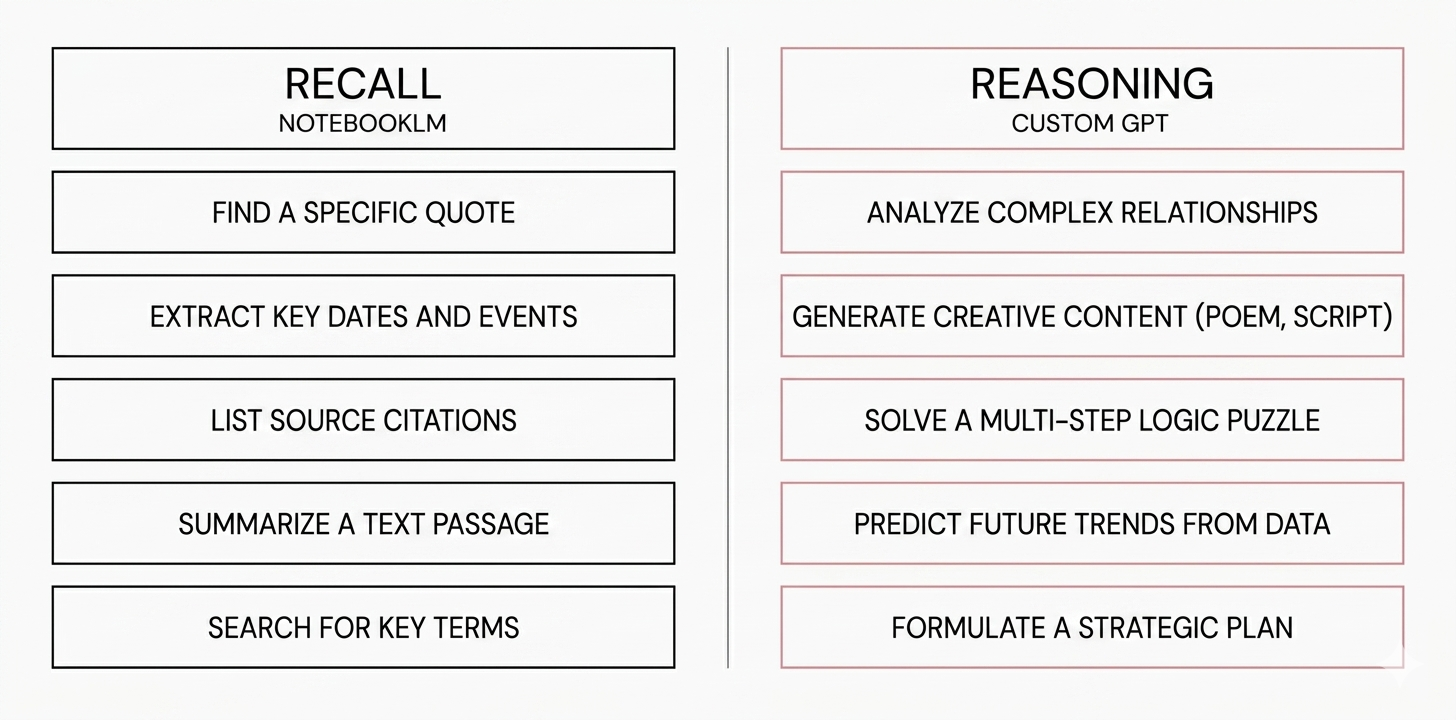
The clearest way to separate them is by the question type.
一 NotebookLM
Botanical names. Extraction methods. Dermal limits. Contraindications. Chemical constituents. Factual retention and rapid-fire recall — do I remember this exactly?
二 Custom GPT
System interactions. Clinical reasoning. Comparative oil logic. Case study thinking. Client safety judgment — do I understand why?
三 Together
Retention without reasoning is fragile. Reasoning without retention is imprecise. Used in combination, they cover the full range the exam actually tests.
What this demonstrates
This is not a story about using AI to study faster. Faster was not the goal.
The goal was to identify what each phase of learning actually requires — and assign the right tool to the right task. Data consolidation is a different problem from clinical reasoning. Retrieval drilling is a different problem from case study preparation. Treating them the same produces a weaker result than treating them differently.
This is the same judgment I apply in client work. Which tool is actually suited to this task? What does this stage of the problem require? Where does automation help, and where does it get in the way?
The context here happens to be an aromatherapy exam. The thinking is the same regardless of context.